


Sovereign AI Key to India’s Transition from Consumer to Global AI Creator
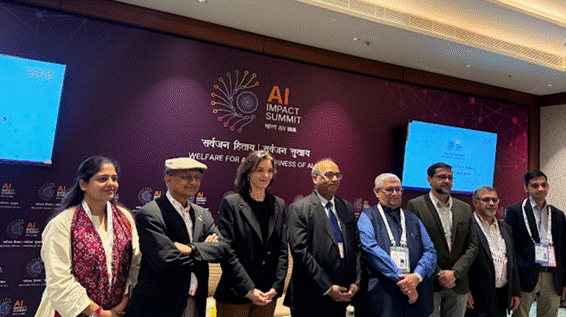

India AI Impact Summit 2026 Session on “Scaling Impact from India’s Sovereign AI and Data” Explores Pathways to Global AI Leadership
(PIB) The session titled “Scaling Impact from India’s Sovereign AI and Data” at the India AI Impact Summit 2026 focused on how India can move from being primarily a consumer of Artificial Intelligence (AI) to becoming a creator of AI systems with global relevance.
The discussion highlighted the need to address gaps in deep research talent and long-term innovation investment. The panel emphasised that true AI capacity is built through sustained research ecosystems and strong mentorship, rather than through short-term interventions. Speakers underlined three key pillars of AI sovereignty: development of indigenous models adapted to Indian languages and social contexts; creation of resilient domestic infrastructure; and strengthening of foundational research.
The session also linked advanced AI research to national priorities such as financial inclusion, agriculture, healthcare, and education. The speakers noted that AI must be aligned with India’s development goals to deliver meaningful and inclusive outcomes.
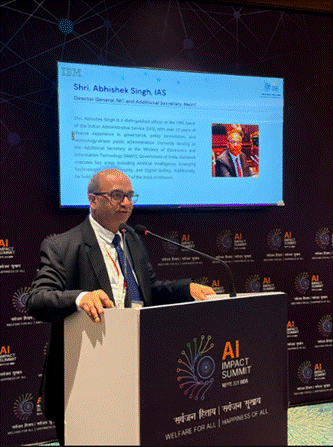
Shri Abhishek Singh, Director General, National Informatics Centre (NIC) and Additional Secretary, Ministry of Electronics and Information Technology (MeitY), stated that sovereign AI does not mean working in isolation. He said that sovereignty in AI means having control over how AI systems are designed, deployed, and governed. He emphasised that AI must be used to solve real challenges in healthcare, education, agriculture, and financial inclusion so that citizens can access services in their own languages and improve their quality of life.
Shri Rishi Bal, Chief Executive Officer, BharatGen, said that AI adoption will take place across sectors but must be phased and carefully implemented, beginning with priority and sensitive areas such as governance, citizen services, and finance. He described AI development as a continuous journey rather than a sector-by-sector deployment exercise. He stressed the importance of building shared digital infrastructure, including common models, inference architectures, and components that enable innovators to build faster and safer solutions. He added that AI sovereignty requires the creation of a national ecosystem of models and infrastructure that can be widely used, while also enabling startups to innovate. He noted that such an ecosystem requires collaborative efforts across the country.
Shri Rajiv Ratan Chetwani, Director, Directorate of Information Systems and Management (DISM), Indian Space Research Organisation (ISRO), highlighted the strategic importance of AI. He stated that for ISRO, sovereign AI is a strategic necessity and a critical infrastructure for space observation and national autonomy. He emphasised that AI systems used in strategic sectors must operate offline without direct internet dependence and must be transparent and auditable. He underlined the need for explainable models, clear data lineage, and training pipelines aligned with national legal frameworks. He added that India’s vast geospatial data resources can be leveraged through AI to strengthen agriculture, disaster management, climate prediction, and urban planning, thereby delivering both security and societal benefits.
The session contributed to the overall focus of the India AI Impact Summit 2026 on strengthening India’s AI ecosystem through sustained research, infrastructure development, and institutional collaboration. The discussions reflected a shared commitment to building long-term capacity to support innovation and advance national priorities.