




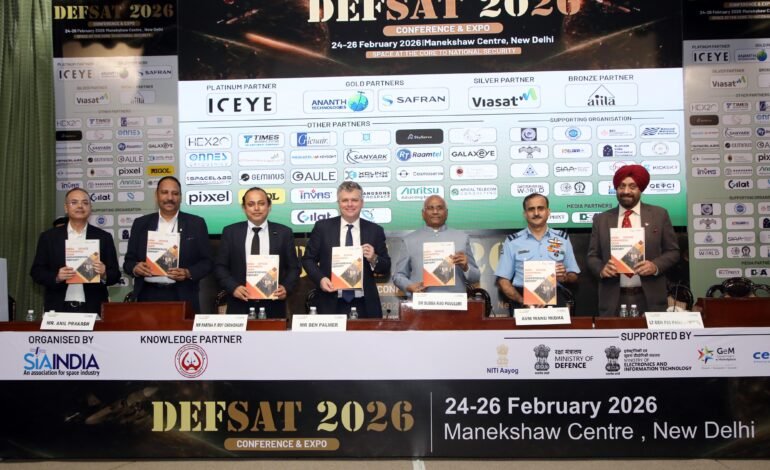

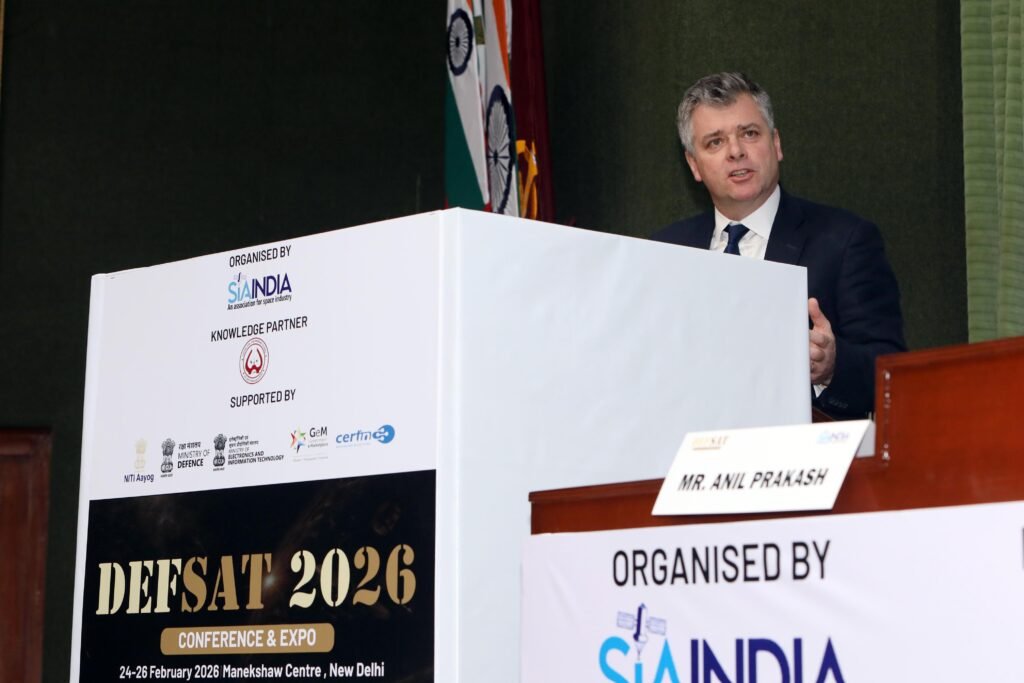
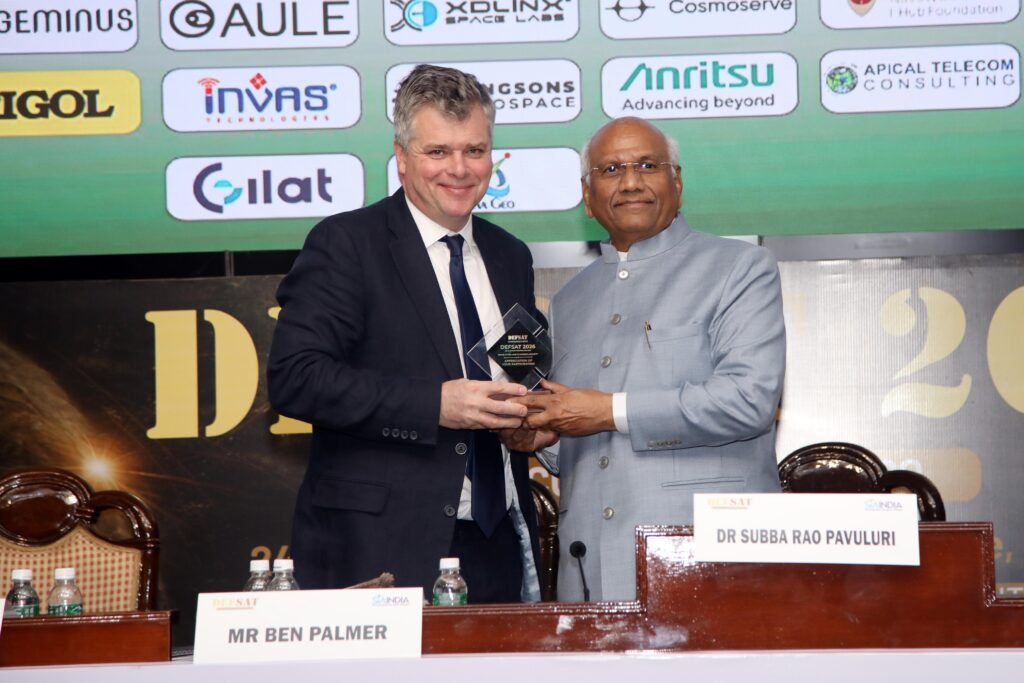
Addressing the opening plenary session, Ben Palmer, President of Viasat Commercial calls forMulti-Orbit, Multi-Band Connectivity to Strengthen India’s Space Sovereignty
Highlighting the need for assured connectivity across alternate orbits and radio frequency bands, Ben Palmer, President, Viasat said, “We’re looking at ways to ensure governments have access to assured connectivity via alternate orbits and alternate radio frequency spectrum. We are innovating to deliver cyber and EW resilience, access to different spectrum and new ways to deliver these key enabling capabilities. Viasat and Inmarsat have come together to form a global partnership, and we are keen to continue to explore how we can work more with local teams, building on our strong partnership with BSNL, to build capabilities for the future in India that meet India’s national security and economic prosperity needs.”
Speaking about the growing role of uncrewed systems and the need for compact, beyond line-of-sight connectivity solutions, he noted, “We have seen in Ukraine the prevalence of uncrewed platforms as a way to achieve decisive military effect without putting people in harm’s way. Our focus is on creating terminals small enough to fit on the most tactical uncrewed platforms, whether they operate on the ground, at sea or in the air. Being able to obtain Beyond Line-of-Sight communications with such a small platform requires special technology, in this case not much larger than a coffee cup. Our work on satellite Direct to Device (D2D) will increase the capability available to the smallest uncrewed platforms.”
Underscoring the foundational importance of space-based infrastructure to both security and economic growth, he said, “The first is that societies cannot function without reliable and valid access to space. Space-based capabilities are, of course, critical to national security. But they underpin much of the economic activities that drive growth and enable national prosperity. In turn, satellite communications underpin every other space mission, serving as the dual use oxygen that breathes life into the sensing, early warning, weather forecasting, navigating, scientific, exploration and entertainment services upon which we all rely. Without assured, resilient, global SATCOM we would all be in the dark.”
Acknowledging India’s long-term strategic approach to space sovereignty, he said, “India lives in a dangerous neighbourhood in an increasingly fractious world. The vastness of the territory, and the extremes of the geography combine with the energy of people, the excellence of India’s scientists and the scale of the economic opportunity. The grand strategic approach which the Government of India is adopting to assure its space sovereignty is impressive. This isn’t just about ‘Make in India’ and assuring freedom of operation, it’s also about the responsible, pragmatic approach that India has adopted in international fora to resist attempts by others seeking market dominance to curtail freedom of choice. This is long term, strategic and wise.”
“Inmarsat – now part of Viasat – has a long history of partnering with Indian institutions and companies to deliver. We employ hundreds of people here, helping to build innovative software-enabled capabilities and we keep India’s ships and airliners and those transiting its territorial waters and airspace safe, enabling global trade to flow smoothly; and in the defence domain our provision of handheld sat-phone services and higher capacity Ka band satellite services in partnership with BSNL and via assured local infrastructure provides the sovereign communications capability required to underpin operational-to-tactical mission superiority” he further highlighted.