





2025 emerged as a defining year for India’s space sector, marking the transition from policy intent to large-scale execution. According to Lt. Gen. AK Bhatt (Retd.), Director General, Indian Space Association (ISpA), the year demonstrated how sustained policy reforms are now delivering tangible outcomes across launch services, satellite manufacturing, Earth observation, space data applications, and satellite communications.
“2025 marked a decisive year for India’s space sector as policy reforms translated into tangible execution across launch, satellite manufacturing, Earth observation, space data, and satellite communications,” Lt. Gen. Bhatt said. “India’s space economy, currently valued at approximately USD 9 billion, is now on a clear trajectory towards USD 44 billion in the coming decade, with growth driven largely by private industry.”
Public–Private Partnerships Move from Policy to Practice
Public–private partnerships (PPPs) became the central operating model across the space value chain in 2025. The New Space Policy 2023, liberalised FDI norms introduced in 2024, and the implementation of the Indian Telecommunications Act 2023 together provided the predictability required for long-term private investment.
A major milestone came in Earth observation, where IN-SPACe’s Build–Own–Operate framework advanced from concept to implementation. Under this model, a Pixxel-led consortium—comprising Pixxel, Dhruva Space, PierSight, and SatSure—secured a ₹1,200 crore government contract to build and operate India’s first commercial Earth observation constellation of 12 satellites. In parallel, the LVM3 heavy-lift launch vehicle PPP progressed, with ISRO and industry collaborating to scale production for commercial missions.
India’s launch industrialisation also gathered momentum. The country’s first fully indigenously manufactured PSLV, produced by the HAL–L&T-led consortium, is expected to fly in early 2026, marking a significant step in transitioning launch systems from agency-led to industry-led production.
Startup Ecosystem Scales Up
India’s space startup ecosystem crossed an important threshold in 2025, with more than 300 active startups now operating across launch vehicles, satellite platforms, Earth observation, satellite communications, propulsion, electronics, space situational awareness, and downstream analytics. India’s share of the global space economy—currently around 2 percent—is projected to rise to nearly 8 percent by 2033, driven primarily by private industry participation.
The year saw a sharp increase in industry-led collaborations. Notable partnerships included Kepler Aerospace and Astrome on satellite swarm communications; Pixxel integrating Dhruva Space’s Solis+ solar panels for its hyperspectral constellation; and Dhruva Space working with SatSure on integrated Earth observation solutions. Other collaborations involved Bellatrix Aerospace with Skyroot Aerospace, Ananth Technologies with Digantara, and Azista partnering with Kepler Aerospace on satellite platforms—reflecting growing maturity and specialisation across the ecosystem.
National Missions Strengthen Strategic and Scientific Capabilities
India’s national missions continued to reinforce the country’s scientific and strategic standing. The NASA–ISRO Synthetic Aperture Radar (NISAR) mission launched in July, providing advanced global monitoring of land, ice, and ecosystems. Chandrayaan-3 continued post-landing scientific operations near the lunar south pole, while the Chandrayaan-2 orbiter sustained valuable lunar observations.
Aditya-L1 began releasing calibrated datasets to the global scientific community, enhancing India’s contribution to solar and heliophysics research. A major technological milestone was achieved with the successful SpaDeX docking demonstration, placing India among a select group of nations with autonomous rendezvous and docking capabilities.
ISRO’s Operational Milestones
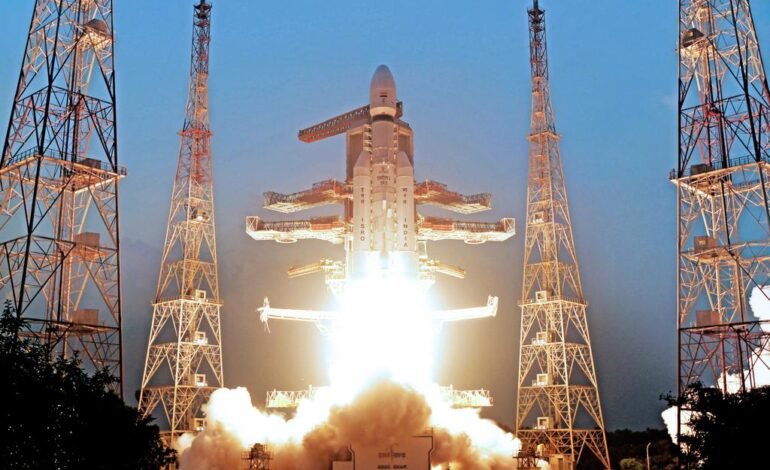
ISRO recorded several landmark achievements in 2025, including its 100th launch from Sriharikota, underscoring the reliability and depth of India’s launch infrastructure. Group Captain Shubhanshu Shukla’s journey to the International Space Station aboard the Axiom-4 mission marked an important step for India’s human spaceflight programme.
Progress on in-orbit robotics experiments aboard POEM-4 and continued preparations for uncrewed Gaganyaan missions further strengthened India’s human spaceflight roadmap, with increasing industry participation across systems and subsystems.
Private Sector Moves from Demonstration to Deployment
Indian private space companies advanced decisively from technology demonstration to commercial deployment. Skyroot Aerospace and Agnikul Cosmos continued progressing private orbital and semi-cryogenic launch systems, contributing to a competitive domestic launch market. Prime Minister Narendra Modi’s unveiling of Skyroot’s Vikram-I launch vehicle and the Infinity Campus underscored growing national confidence in private launch capabilities.
HAL won the bid to manufacture and commercialise the Small Satellite Launch Vehicle (SSLV), establishing a new model for industry-led launch services. Pixxel deployed India’s first private satellite constellation—the Firefly series—launching six hyperspectral satellites in 2025 using SpaceX Falcon 9 rockets. Digantara strengthened India’s space situational awareness capabilities with the launch of its first commercial surveillance satellite, SCOT, while companies such as Bellatrix Aerospace, ThrustWrks, OmSpace, Xovian, and GalaxEye demonstrated operational capabilities across propulsion, subsystems, and imaging platforms.
Space Data and National Infrastructure
The space data economy gained strong momentum in 2025, with Earth observation data increasingly supporting agriculture, disaster management, infrastructure planning, climate monitoring, and defence. The Union Budget 2025–26 reinforced policy support through initiatives such as the National Geospatial Mission, a Fund of Funds for startups, enhanced credit guarantee mechanisms, expansion of Atal Tinkering Labs, and a dedicated DeepTech Fund of Funds.
IN-SPACe’s Technology Adoption Fund, launched in February, focused on indigenisation and manufacturing scale-up, while several states announced space-focused policies, signalling alignment across national and state priorities.
A notable highlight was Operation Sindoor, which showcased India’s evolving space-enabled operational capabilities. Indigenous assets such as Cartosat-2C and RISAT were integrated with commercial satellite imagery from Indian companies to deliver real-time intelligence, surveillance, and reconnaissance. The operation underscored the need for expanded constellations, prompting the government to fast-track the SBS Phase 3 programme—52 dedicated satellites for the armed forces, with 31 to be built by Indian private companies.
Satellite Communications: Regulatory Progress and Urgency
Satellite communications witnessed meaningful regulatory movement during the year. TRAI issued recommendations on satellite spectrum pricing and provided clarity on administrative allocation and shared access. The Department of Telecommunications removed numerical caps on SATCOM users, linking authorisations to capacity cleared by IN-SPACe, and advanced draft authorisation rules alongside the issuance of GMPCS licences.
However, the industry continues to await the government’s final decision on spectrum allocation. “Any further delay represents a significant opportunity cost,” Lt. Gen. Bhatt noted, urging swift action to enable commercial SATCOM services, bridge the digital divide, and support future 6G-era connectivity.
Investment and Institutional Support
Private space startups in India raised nearly USD 150 million during FY 2025, taking cumulative funding to over USD 617 million. The operationalisation of the ₹1,000 crore IN-SPACe Venture Capital Fund and approval of the ₹1 lakh crore Research, Development and Innovation Scheme added long-term depth to the funding ecosystem. IN-SPACe’s ₹500 crore Technology Adoption Fund is expected to further accelerate commercially viable early-stage space technologies by supporting startups and MSMEs.
Looking Ahead
By the end of 2025, India’s space sector had firmly entered an execution-led phase. While challenges remain in manufacturing scale, access to long-term capital, and assured demand, the year established a strong foundation for sustained growth, deeper industry participation, and India’s expanding role in the global space economy.
As Lt. Gen. Bhatt concluded, 2025 will be remembered as the year India’s space ambitions decisively moved from promise to performance.